By
 Copy URL to Clipboard
Importing beauty products from Canada is a cross-border compliance process that requires U.S. importers to meet U.S. Customs and Border Protection (CBP) and U.S. Food and Drug Administration (FDA) requirements. Importers must prepare accurate documentation, coordinate regulatory requirements, and ensure the shipment is ready to move across the border.
That may sound like a lot. It is. But it is also manageable when the details are handled early.
Here’s how the process of importing beauty products and cosmetics works, and what you need to know to get started.
Table of Contents
Yes. Canadian beauty products can be imported into the United States, but products entering the U.S. must meet applicable U.S. customs and regulatory requirements. For many beauty products, that means dealing with two different parts of the import process.
Beauty products are subject to customs and transportation requirements, including:
And product-specific requirements, which may include:
The FDA works with CBP to monitor imported cosmetics, and products offered for import must comply with the same applicable FDA laws and regulations as cosmetics produced in the United States.
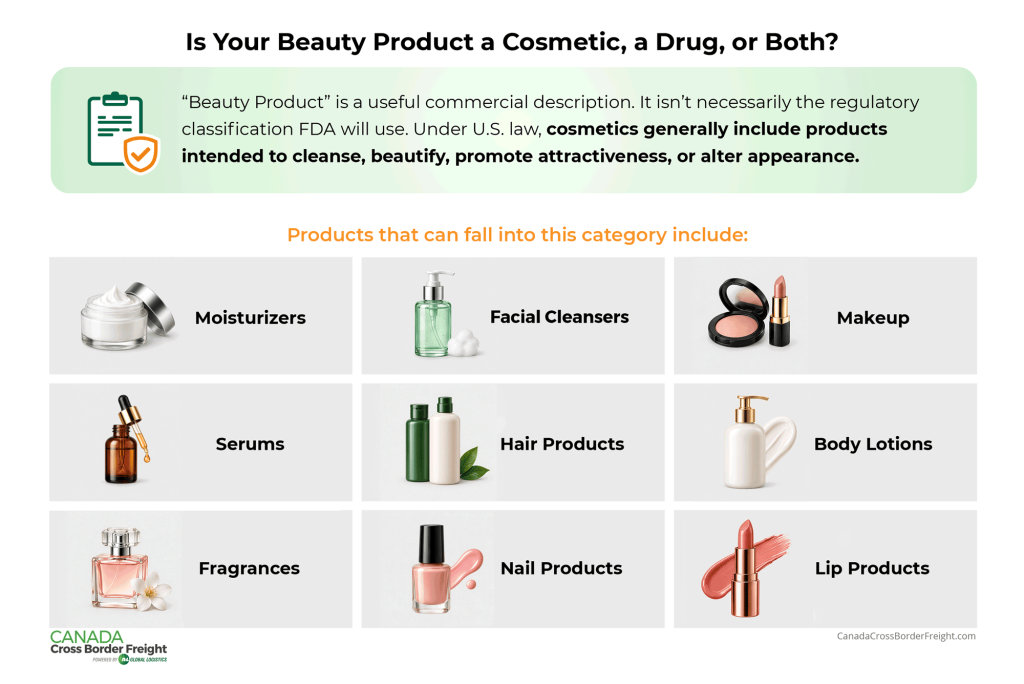
“Beauty product” is a useful commercial description. It isn't necessarily the regulatory classification FDA will use. Under U.S. law, cosmetics generally include products intended to cleanse, beautify, promote attractiveness, or alter appearance.
That can include products such as:
However, a product’s intended use, including the claims made about it, can change how FDA regulates it.
Some products commonly sold alongside cosmetics may instead be drugs or both cosmetics and drugs under U.S. law. FDA specifically notes that regulatory definitions can differ between countries. This is especially important to importers because a product subject to drug requirements can face substantially different import and compliance requirements.
Every shipment is different, but commercial beauty importers will typically need to work through several key questions before their goods cross the border.
Imported merchandise must be classified under the Harmonized Tariff Schedule of the United States.
The HTS classification helps determine the applicable duty rate and can affect other entry requirements. CBP notes that the requirements for a specific imported product can depend on its tariff classification.
For beauty products, don’t assume that similar-looking products necessarily receive the same classification.
The ingredients, composition, intended use, packaging, and other product characteristics can matter.
Importers also need to properly declare the value of their merchandise. That value can affect duties, taxes, fees, bond requirements, and other parts of the customs entry.
This can be surprisingly confusing for a new importer, especially when an application asks for estimated annual import value or anticipated duties before the business has established a U.S. import history.
Avoid plugging in a number simply because the form requires one. Estimates used for customs and bond purposes should be based on supportable business information.
A customs bond guarantees that CBP will receive duties, taxes, and fees associated with an import.
Importers generally choose between:
For businesses planning to import beauty products from Canada regularly, a continuous bond may make more sense than arranging a new bond for each shipment. CBP currently sets the minimum continuous import bond amount at $50,000, with higher amounts potentially required based on duties, taxes, and fees.
And for a first-time importer, completing that bond application can become one of the most confusing parts of getting started.
One Canadian beauty business recently came to our team while preparing to import products into the United States for the first time.
The products were ready. The business was ready. The continuous customs bond was not.
As a first-time importer, the client had questions about several parts of the application, including:
The importer had already purchased the bond, but getting the application completed correctly required several follow-up conversations, document updates, and corrections.
As the client explained: “It’s my first time doing it, so I need guidance because there are parts of the form that I don’t understand. I just want to make sure everything is correct.”
And there was a very practical reason for getting it right: “I’m trying to get this completed fairly quickly so there’s no delay in the process. I just need this part completed so I can resume my business operations.”
Our team helped the importer work through the application, correct previously submitted information, determine what supporting documentation was needed, and monitor the process. Delays were avoided and her business continued to thrive.
The lesson isn’t that customs bonds are inherently difficult. It’s that customs paperwork becomes a logistics problem when incomplete or inaccurate information keeps freight from moving.
For first-time importers especially, working through those questions before the shipment reaches the border can prevent an administrative issue from becoming a transportation delay.
Crossing the U.S.-Canada border doesn’t exempt cosmetics from U.S. requirements. Imported cosmetics must meet the same applicable U.S. laws and regulations as domestically produced cosmetics. FDA can examine imported cosmetics, and products that appear to be adulterated or misbranded may be refused entry.
Fortunately, traditional cosmetics generally do not require FDA premarket approval. The primary exception is certain color additives.
That doesn’t mean anything goes. The company responsible for the product still has to ensure it is safe for its intended use, properly labeled, and compliant with applicable U.S. law.
For imported cosmetics, FDA may review information transmitted as part of the customs entry, including:
The FDA says providing complete and accurate entry information can help its systems process an import electronically instead of sending it for additional manual review. Translation: the paperwork isn’t just busy work or pencil pushing. It can affect how quickly your shipment gets through the import process.
MoCRA significantly expanded the FDA’s authority over cosmetic products.
Among other requirements, certain cosmetic manufacturers and processors must register their facilities with the FDA, while responsible persons must list marketed cosmetic products.
Exemptions and different requirements can apply depending on the business and product.
If you're sourcing beauty products from a Canadian manufacturer, don’t wait until the freight is moving to determine whether applicable U.S. cosmetic compliance requirements have been addressed.
The exact documentation required depends on the shipment, commodity, importer, and entry.
Documents and information commonly involved in a commercial Canada-to-U.S. shipment may
include:
Your customs broker, freight provider, or other trade professional may request additional documents based on the specific products and circumstances.
The important part is making sure the information is consistent across those documents. A beautiful shipment of perfectly packaged serums can still have a very ugly day at the border if the paperwork doesn't match.
Maybe.
But shipping from Canada and originating in Canada are not automatically the same thing.
A product may qualify when it is wholly obtained or produced in North America, produced entirely from originating materials, or produced using non-originating materials while satisfying the applicable USMCA product-specific rules and other requirements.
For example, a skincare product packaged and shipped by a Canadian company isn't necessarily Canadian-origin for USMCA purposes simply because the carton leaves from Ontario.
Ingredients and manufacturing can matter. Determine eligibility before claiming preferential treatment rather than assuming that a Canadian shipping address makes the product duty-free.
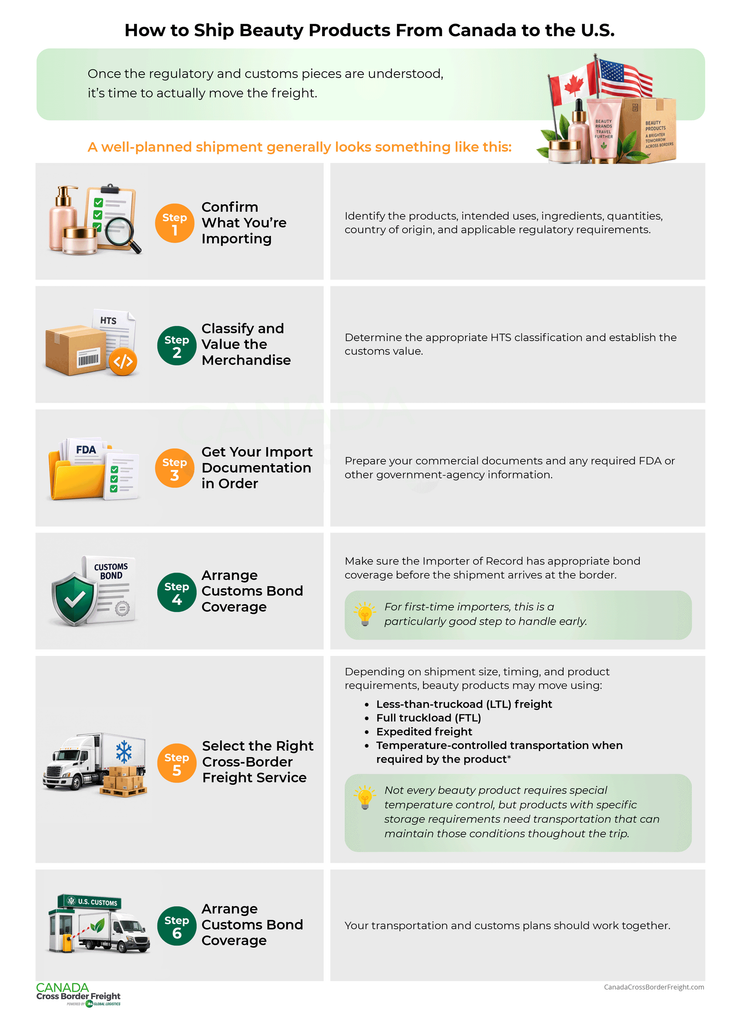
Once the regulatory and customs pieces are understood, it’s time to actually move the freight.
A well-planned shipment generally looks something like this:
Identify the products, intended uses, ingredients, quantities, country of origin, and applicable regulatory requirements.
Determine the appropriate HTS classification and establish the customs value.
Prepare your commercial documents and any required FDA or other government-agency information.
Make sure the Importer of Record has appropriate bond coverage before the shipment arrives at the border.
For first-time importers, this is a particularly good step to handle early.
Depending on shipment size, timing, and product requirements, beauty products may move using:
Not every beauty product requires special temperature control, but products with specific storage requirements need transportation that can maintain those conditions throughout the trip.
Your transportation and customs plans should work together.
A truck arriving before the entry documentation is ready doesn’t make the shipment faster. It gives the truck something to do while everybody sorts out the paperwork.
The smoother approach is coordinating documentation, customs clearance, border crossing, and final delivery as one process.
Many import problems are preventable.
Before your products start moving, watch for common mistakes such as:
That last one deserves extra attention. A cross-border supply chain only works when the freight and compliance pieces meet in the middle.
There are a lot of moving pieces involved in importing beauty products from Canada, especially when it’s your first shipment.
But they don’t have to be surprises.
Confirm your product requirements. Get your customs documentation and bond coverage in order. Make sure the information provided to CBP and FDA is accurate. Then build a transportation plan around a shipment that's actually ready to cross the border.
R+L Global Logistics helps businesses coordinate freight moving between Canada and the United States, with cross-border transportation solutions designed around the needs of the shipment.
Whether you’re shipping your first load of Canadian skincare or managing an established beauty supply chain, we'll help you get your freight where it needs to go. Get a cross-border freight quote now.
Copy URL to Clipboard

